Robust Redhorse Habitat Restoration
Oconee River Gravel Augmentation Project, GA DNR
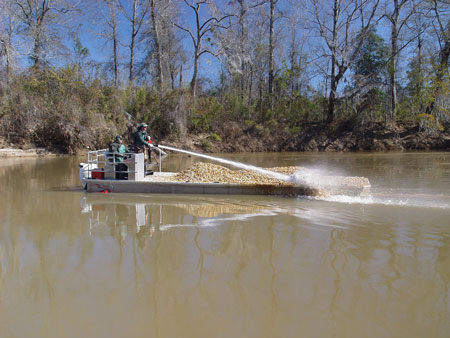
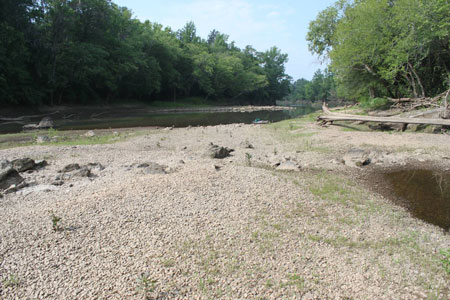
In 2009 and 2010 four sites on the Oconee River between Milledgeville and Dublin, Georgia were augmented with a total of 1,019 tons of additional gravel using a barge loaded with gravel by a portable conveyor. Gravel was then transported to each of the four sites located 0.1 to 5 km from access points. The gravel was washed off the barge onto target areas using a high-pressure water pump. Three sizes of gravel were mixed to replicate particle sizes described from other active spawning sites and deposited to depths of 15 to 25 cm. Monitoring to date during low flow periods indicates that gravel has persisted at each of the augmentation sites and that potentially suitable spawning habitat has been created. Beginning in 2013 a more extensive study will be conducted to monitor robust redhorse spawning activity at the four gravel augmentation sites and one natural spawning site on the Oconee River.
Oconee River Revetment Project, NRCS
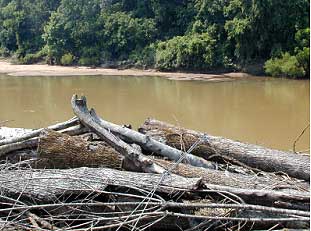
In 2000, the Natural Resources Conservation Service with the U.S.D.A. worked with a private landowner to stabilize approximately 1100 linear feet of bank on the Oconee River in Georgia. The project was a test case for the long-term effects of restoration practices on large rivers. Its main purposes were to help collect sediment and prevent further localized bank erosion.
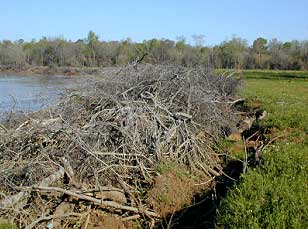
Restoration practices involved cutting 700, 8 - 24 inch diameter trees from the landowner's property and placing them along the 1100-foot section. Starting at the downstream end, 5/16-inch cable (see photo above) was laid across the bank and into the river every 25 feet. The trees were placed on top of the cable parallel to the bank, branches facing downstream with the larger trees on the bottom.
The trees were compacted with a track hoe to a height that was slightly above the bank (see photo above). The cables were then walked back to the bank, cinched down over the tree mass and anchored around a large log (dead man, 12 - 24 inches in diameter, 6 feet long) that was buried in a trench perpendicular to the bank 6 - 8 feet deep. The final restoration practices will include reforestation of a 100-foot buffer along the bank, which will be fenced to keep cattle out of the river.
Robust Redhorse Restoration and Habitat Improvement Project on the Ocmulgee River
A habitat improvement project on the Ocmulgee River in Georgia is a joint effort between RRCC partners: Georgia River Network, U.S. Forest Service, Georgia Department of Natural Resources and Georgia Power Company. The National Fish and Wildlife Foundation provided funding for the Wise Creek Recreation Area to stabilize and revegetate 190 linear feet of bank that is severely undercut and eroded. Further improvements and maintenance to a river access road will help prevent sediment from entering the river. This robust redhorse habitat improvement helps meet important RRCC goals and compliments the reintroduction efforts being conducted under the Candidate Conservation Agreement with Assurances.
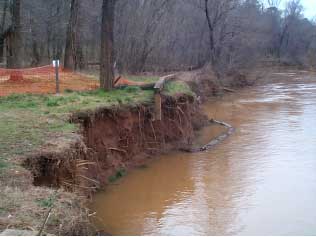
Wise Creek Recreation Area Habitat Restoration Project - Before restoration bank is severely undercut and eroding.

After restoration bank is stabilized.